

Review: 'Send Help' Successfully Has Its Cake and Eats It Too
Rachel McAdams and Dylan O'Brien shine in Sam Raimi's survivalist thriller that excels as a sporting satire of conventional genre and cultural narratives.

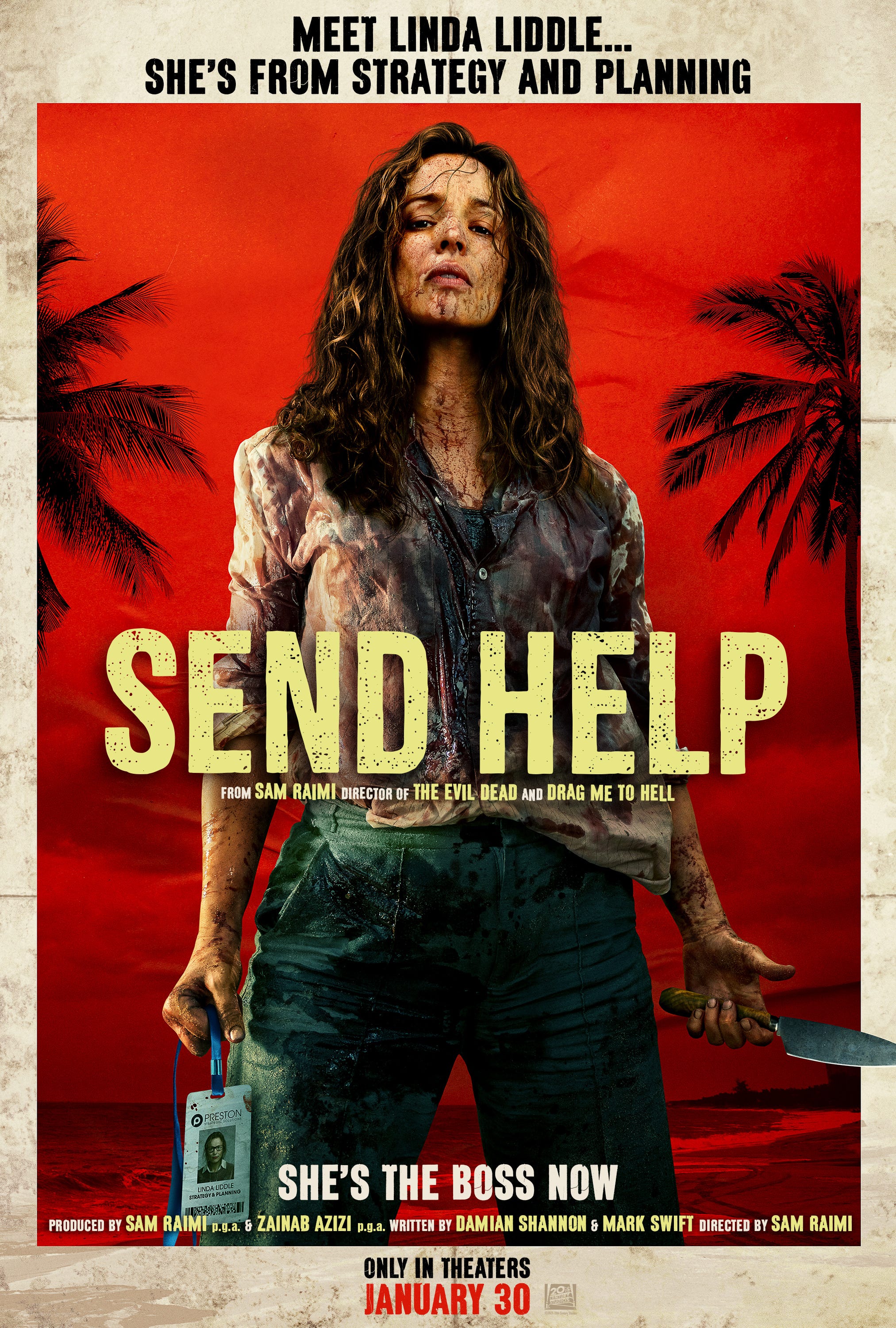
Send Help
2026/113 minutes/rated R
Directed by Sam Raimi
Written by Damian Shannon and Mark Swift
Produced by Sam Raimi and Zainab Azizi
Starring Rachel McAdams and Dylan O’Brien
Cinematography by Bill Pope
Edited by Bob Murawski
Music by Danny Elfman
A Raimi Productions film
Opening January 30 via 20th Century Studios
It is exceedingly rare for me to spend the duration of a major studio theatrical release unsure about A) what’s going to happen next and/or B) how the resolution might play out. And yet, once the inciting plays out, namely a plane crash that strands a nepo baby CEO (Dylan O’Brien) on a desert island alongside only one of his most reliable but least appreciated employees (Rachel McAdams), all bets are off.
Yes, as highlighted in the trailers, the underling becomes the authority figure. And yes, there’s a certain expected give-and-take in terms of reluctant cooperation for the sake of mutual survival and attempts to reassert the expected hierarchy. Yet Damian Shannon and Mark Swift’s clever and propulsive screenplay avoids too aggressively tilting the scales of moral superiority in favor of either stranded party. Sure, the boss is a sexist asshole, but how much turnabout qualifies as fair play?
Yes, this is yet another “major” movie that begins as a conventional “multiple characters in multiple locations” narrative, only to quickly isolate one or two key protagonists in a single locale. However, while noting that decade-long pet peeve (quality notwithstanding, compare Arrival to Contact and realize that Gloria Swanson was eventually correct), I’ll happily admit that Send Help feels big enough and sprawling enough to justify a big-screen viewing.
That’s doubly true if you are lucky enough to live near a populated multiplex and can enjoy this one with a stereotypical Saturday night crowd that can be expected to react the right way at the right times. Regardless, there’s enough visual variety amid the single deserted island and enough “action” and/or “incident” to avoid potential claustrophobia. Besides, Raimi and friends are smart enough to know that the real fireworks will be the proverbial “acting duals” between O’Brien and McAdams.
The film’s best sequence is a quiet, nuanced conversation as Linda and Bradley hash out their respective past-tense turmoil. It’s a stupidly well-acted scene that A) is refreshingly specific and B) allows the audience to merely guess the reliability of each narrator. Both McAdams and O’Brien are meta-contextual choices for the leads.
McAdams burst onto the scene in the mid-2000s right as Hollywood was about to stop making the kind of films (rom-coms, melodramas, and real-world thrillers) that would have otherwise given her a plethora of star vehicle opportunities. O’Brien seemed to be on the movie star track right as the bottom fell out for “just a movie” studio releases.
Neither actor necessarily deserves our pity, as McAdams seems to work when she wants to, and even O’Brien has done good work in interesting programmers like Love and Monsters and The Outfit, but the onscreen team-up feels almost self-aware.
If I seem to avoid talking about the movie itself, it’s because I don’t wish to spoil its various plot-specific and character-specific surprises. However, in less surprising developments, McAdams again proves herself a superb comic actress and a deliciously expressive performer.
Raimi and Pope deliver the cinematic splendor and R-rated violence when appropriate. However, there is a shocking subtlety to the screenplay in not spelling out certain elements, such as McAdams’s “from ugly duckling to swan” transformation, and in never prematurely declaring the extent of any romantic spark between the two plane-wrecked survivors.
That’s not to say these feelings or lack thereof, or even secondary motivations in terms of rescue versus survival, are left a mystery. However, little is spelled out when it doesn’t need to be, as this is not a film written or directed for the “watch it while scrolling on your phone” crowd.
Taken as a whole, sans details, Raimi, Shannon and Swift’s comic thriller works as a kind of self-critical but sporting satire of the “good for her” sub-genre. If you want to get more navel-gazy, I’ll argue that it’s an implicit commentary on the extent to which white female victimhood can be seen as a justification for disproportionate, including collateral damage, retribution.
Yes, I can nitpick here and there. Yes, the finale involves a little too much “here’s how we got here” visual and verbal exposition for earlier elements (not mind-breaking plot twists) that the film had successfully “shown, not told.” However, it’s not remotely a dealbreaker for what remains a gleefully funny and dramatically compelling battle of wits.
Send Help is a rollicking good time at the movies for grown-ups, young adults, and kids old enough to handle pulpy R-rated thrills and chills, with Raimi again showing the value of having a distinctive filmmaker deliver a B-movie with A-level craft.
